Why contemporary worship leaders shouldn’t ignore the old songs their churches still know and love
You have your Sunday set planned. The songs flow, the keys work and your band is ready. Then your pastor forwards you an email from a church member:
Can we please sing some of the old hymns?
Or maybe it’s a comment card after the service:
Where are the old hymns we used to sing?
For a lot of modern worship leaders, that kind of request doesn’t feel like a neutral suggestion. It feels like criticism. Like someone just told you your worship is too new, too loud, too shallow, or not spiritual enough.
I want to tell you something that might change the way you think about those requests: hymns are not the enemy of your modern worship set. They never were.
Why “Hymns Versus Modern Worship” Is the Wrong Debate
Most of the tension around hymns comes from a question that’s badly framed from the start. The question most churches are asking (whether they say it out loud or not) is: “Should we sing old songs or new songs?”
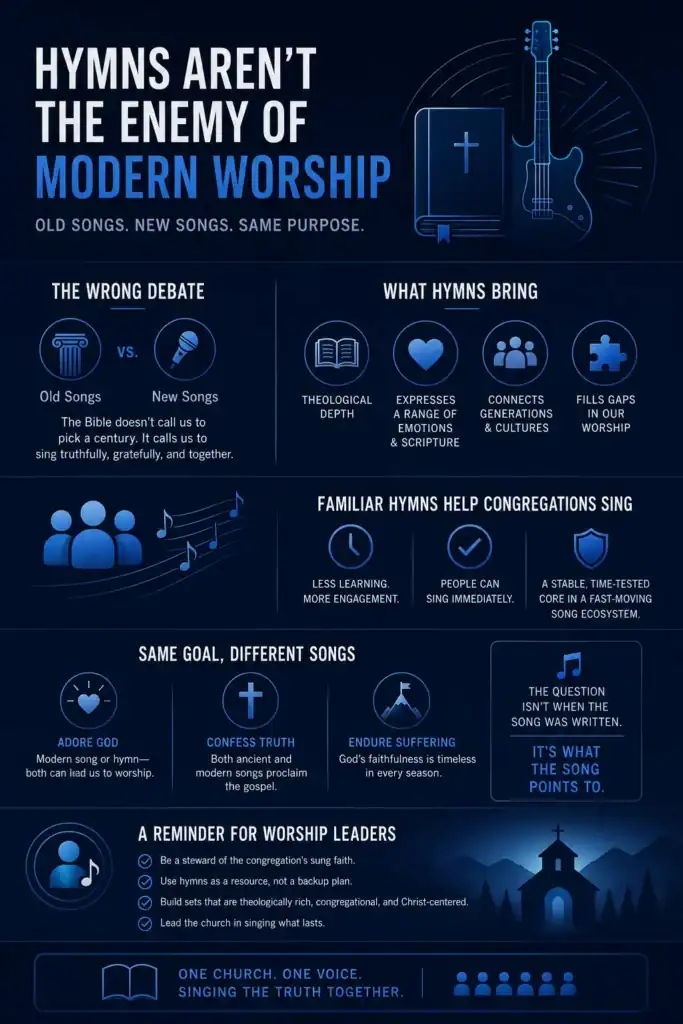
That’s the wrong question. The Bible doesn’t command churches to pick a musical era. It calls the church to sing truthfully, gratefully, and together.
Colossians 3:16 connects congregational singing with letting Christ’s word dwell richly among believers. Ephesians 5:19 describes the church addressing one another with psalms, hymns, and spiritual songs. Notice what’s missing from both of those passages: any instruction about which century the songs should come from!
A hymn can be sung selfishly. A modern song can be sung reverently. An organ can serve the congregation. So can an electric guitar. The issue isn’t the instrument or the copyright date. The issue is whether the church is being led to behold, respond to, and proclaim the truth of God.
Reformed Worship makes a similar observation: both modern worship and traditional hymn singing can drift into consumerism when worship planning starts with what people prefer rather than with who God is and how the congregation is called to respond. The style isn’t the problem. The posture is.
So let me say it plainly: old doesn’t automatically mean faithful, and new doesn’t automatically mean shallow. Some hymns are wonderful. Some are sentimental, obscure, or theologically thin. Some modern songs are forgettable fluff. Some are rich, biblical, and deeply congregational. The worship leader’s job isn’t to defend a decade. It’s to be a steward of the congregation’s sung faith.
What Hymns Actually Bring to a Modern Worship Set
Once you stop treating hymns as the opposition, you can start seeing them for what they really are: a resource.
Hymns often carry dense biblical and doctrinal truth in a memorable, singable form. They were written in eras when congregational songs were expected to teach. Think about what “Holy, Holy, Holy” does in just four verses: Trinity, holiness, creation, and eternal worship. Or what “And Can It Be” does with grace, justification, and freedom from condemnation. Or what “It Is Well with My Soul” does with suffering, assurance, and eschatological hope. Try getting all of that into a single modern worship song. It’s possible, but it’s not easy.
The Calvin Institute of Christian Worship points out that contemporary congregations are rediscovering hymns precisely because they carry theological depth, express a broad range of emotions and Scripture, and help connect generations and cultures. That’s not nostalgia, that’s a recognition that hymns fill gaps many modern worship sets didn’t even know they had.
Here’s a practical exercise. Pull up your setlists from the last eight to twelve weeks and ask yourself a few questions. Have you sung about the cross clearly? Have you sung confession? Lament? Assurance? Have you sung anything that addresses the congregation to one another, not only to God? Have you sung something a believer could carry into a hospital room, a funeral, or a season of real doubt?
If you find gaps (and most of us do), hymns might be exactly the resource that fills them!
Why Familiar Hymns Help Congregations Sing in Modern Worship
There’s another thing hymns bring to the table that gets overlooked: familiarity.
Every new song asks the congregation to learn melody, rhythm, structure, and lyrics all at the same time. That’s a big ask, especially when your church is learning two or three new songs a month. Remember, we as worship leaders who are on top of what’s the latest music, might tire of a worship song before the congregation ever hears it! A familiar hymn lets many people engage immediately. They know where the melody goes and can probably sing it without looking at the screen.
A 2026 Worship Leader Magazine analysis found that the current worship song ecosystem moves fast. Nearly half of the unique songs on the major worship charts (CCLI, MultiTracks, PraiseCharts) had been released in just the previous couple of years, and only two songs appeared on all three lists. That’s a lot of churn! Hymns can provide a stable, time-tested core alongside your newer songs, so your congregation isn’t constantly learning and constantly forgetting.
How Hymns and Modern Songs Serve the Same Worship Goal
This is the part I really want you to hear. Hymns and modern worship songs aren’t competing: they’re serving the same purpose.
Both can help the church adore God. A current worship anthem can help your congregation declare God’s goodness with joy. So can “Praise to the Lord, the Almighty.”
Both can help the church confess truth. A modern song can proclaim the gospel clearly. So can “And Can It Be.”
Both can help the church endure suffering. A current song about God’s faithfulness may encourage someone walking through a hard season. So can “It Is Well with My Soul,” and it’s been doing that for over 150 years!
The question isn’t whether a song was written in 1723 or 2023. The question is whether it helps the gathered church sing the truth of God with faith, gratitude, and one voice.
The Real Enemy Isn’t Old Songs or New Songs
If hymns aren’t the enemy of modern worship, what is?
Shallow, careless, unpastoral worship planning. That’s the enemy.
A church that only sings what was released this month may feel current, but it can become spiritually thin. A church that only sings what was written before 1950 may feel reverent, but it can become disconnected from the living, active faith of today’s believers. The best worship leaders aren’t defenders of a style. They’re pastors who choose songs (old and new) that help the whole body worship God together.
A worship leader who can lead both a new chorus and an old hymn isn’t less modern. That leader is more pastoral.
Over the next several articles, I’m going to walk through exactly how to make this work. We’ll talk about why hymn requests feel so personal (and how to respond well), what makes a hymn arrangement actually work for a modern band, where to place hymns in a contemporary worship flow, and how to start adding hymns without disrupting your whole worship culture.
This isn’t about going backward. It’s about giving your church a deeper, wider, more durable collection of songs to sing together.
Bottom Line: Hymns aren’t the enemy. They’re a tool, and when you learn to use them well, they can make your modern worship stronger, not weaker.

Don Chapman is an arranger, composer and worship leader with over 20 years of experience creating resources for the local church. He created Worshiphymns.com to give worship leaders fresh, contemporary arrangements that make it easy to weave classic hymns into modern worship sets.